
Hair transplant in Turkey is one of the most sought-after options for men and women experiencing baldness, thinning areas, or a receding hairline, thanks to the availability of specialized centers, modern techniques, and support services that make the experience easier for patients traveling from outside Turkey.
At Tabeebak Healthcare, we help you make the right decision before traveling by providing an initial assessment of your condition, identifying the most suitable technique, estimating the number of grafts required, and explaining the expected cost based on your photos and the condition of your donor area.
If you are considering restoring your hair density and natural appearance, you can send your photos now to receive a free initial assessment and find out whether you are a suitable candidate for the procedure.
Turkey has become one of the leading destinations for hair transplant procedures, particularly for patients traveling from Arab countries and Europe, due to its combination of medical expertise, variety of techniques, and competitive costs compared with many other countries.
The success of a hair transplant does not depend solely on the country. It also depends on choosing the right doctor or center, accurately evaluating the condition, designing a natural-looking hairline, and following post-procedure instructions.
Some of the main reasons for choosing Turkey include:
However, you should not choose a center based on price alone. The experience of the medical team, sterilization standards, the number of procedures performed each day, and the clarity of the treatment plan before booking are more important.
Hair transplantation may be a suitable option for people with stable hair loss or noticeable thinning areas on the scalp, provided that they have a good donor area at the back or sides of the head.
The condition is usually evaluated based on:
Hair transplantation is not suitable for everyone, so a medical evaluation should be performed before making the final decision.
You may be a good candidate for the procedure if you have one or more of the following conditions:
If hair loss is very active or widespread across the entire scalp, the doctor may first need to determine the cause and develop a treatment plan before considering transplantation.
Hair transplantation may not be the best option in some cases, such as:
For this reason, we always begin with an initial assessment before recommending any technique or center.
At Tabeebak Healthcare, we do not simply send you a general price quote. We help you understand your condition more clearly before traveling so that you can determine whether the procedure is suitable for you.
The initial assessment process includes:
After that, you are guided toward the most suitable option based on your condition, budget, and expectations.
Send Your Photos Now and Get a Free Initial Assessment
Several hair transplant techniques are available in Turkey, and the most suitable technique depends on the condition of your hair, the strength of the donor area, the number of grafts required, and the desired result.
There is no single technique that is suitable for everyone. The best approach is always to choose the technique after a medical evaluation.
FUE, or Follicular Unit Extraction, is one of the most commonly used hair transplant techniques. It involves individually extracting grafts from the donor area and then implanting them into areas affected by thinning or baldness.
This technique may be suitable for many cases, particularly when the donor area is strong and a larger area needs to be covered.
What You Should Know:
This technique may require shaving the entire head, and the quality of the result depends greatly on the medical team’s experience in extracting and preserving the grafts and creating recipient channels at the correct angles.
The DHI technique involves implanting grafts using special devices known as Choi Implanter Pens, in which the graft is loaded into the pen and implanted directly into the recipient area.
This technique may be suitable for certain cases requiring greater density or transplantation in specific areas without completely shaving the hair, depending on the doctor’s assessment.
What You Should Know:
DHI requires an experienced medical team and may have a higher cost than FUE at some centers. It is also not always the best option for cases requiring a very large number of grafts.
Sapphire FUE is an advanced form of the FUE technique in which blades made from sapphire are used to create channels in the recipient area.
The technique aims to create precise channels that allow grafts to be implanted at appropriate angles, which may help achieve a natural appearance and improved density depending on the individual case.
What You Should Know
Despite advances in the tools used, the experience of the doctor and medical team remains more important than the name of the technique itself. The technique alone cannot guarantee the result.
PRP injections may be used as a supportive treatment after hair transplantation in certain cases. This technique uses components obtained from the patient’s own blood after processing, which are then injected into the scalp to support the grafts and promote recovery.
PRP may help with:
However, PRP is not an alternative to hair transplantation, and not every patient necessarily needs it.
The best technique is not always the most expensive one, and there is no single technique that is best for every patient.
The choice of technique depends on:
After you send your photos, the medical team can assess your condition and recommend the most suitable technique for you.
The hair transplant procedure involves several stages, beginning before you travel and continuing through post-procedure follow-up. Understanding these steps can help you prepare more effectively.
The process begins by sending clear photos of your scalp from several angles. Based on these photos, an initial assessment is performed to determine:
This stage is very important because it helps prevent random decisions and allows you to understand realistic expectations before booking.
After arriving at the center, your scalp is examined directly. The doctor or specialized medical team evaluates the donor and recipient areas, and the hairline is then designed according to your facial features, age, and the density that can realistically be achieved.
Hairline design is one of the most important steps of the procedure because an unnatural hairline can affect the appearance of the face for many years.
Before the procedure begins, some basic tests may be performed to ensure that the patient is ready. The steps of the procedure and relevant instructions are also explained.
At this stage, the final number of grafts is determined based on the in-person assessment.
Hair transplantation is usually performed under local anesthesia, meaning the patient remains awake while the scalp is numbed to reduce discomfort during the procedure.
The patient may feel some discomfort when the anesthesia is initially administered, after which the area becomes well numbed.
Grafts are extracted from the donor area, usually from the back or sides of the head, as hair in these areas is generally more resistant to hereditary hair loss.
This stage should be performed carefully to avoid damaging the donor area or extracting more grafts than appropriate.
After extraction, the grafts are sorted and prepared for transplantation. They are handled carefully to preserve their quality before being transferred to the recipient area.
Proper preservation of the grafts during the procedure can affect their survival and subsequent growth.
Depending on the selected technique, small channels may be created in the recipient area, or the grafts may be implanted directly using DHI pens.
At this stage, the direction, angle, and density of the transplanted hair are determined, which are among the most important factors in achieving a natural appearance.
The grafts are carefully distributed across the required areas while taking the natural hair pattern into account. Single-hair grafts are generally placed along the frontal hairline, while grafts containing two or more hairs are used in areas where greater density is needed.
After the transplant is completed, the patient receives detailed instructions regarding:
Following these instructions plays an important role in protecting the grafts during the first few days.
The duration of the procedure varies depending on the number of grafts and the technique used, but it usually takes several hours on the same day.
For cases requiring a large number of grafts, the procedure may take longer. Afterward, most patients can return to their hotel on the same day while following the medical instructions provided.
The cost of hair transplant in Turkey varies from one case to another, and an exact price cannot be determined before reviewing the patient’s photos or conducting an in-person examination.
The cost is influenced by several factors, including:
At Tabeebak Healthcare, we help you determine an appropriate approximate cost for your case after reviewing your photos and establishing an initial treatment plan.
For complete details, you can read our guide: Hair Transplant Cost in Turkey.
Packages vary from one center to another, but some may include services designed to make the treatment journey easier for patients traveling from abroad.
A hair transplant package in Turkey may include:
Before booking, it is important to know exactly what the package includes and which services may require an additional fee.
The final results of a hair transplant do not appear immediately. It is normal for the transplanted hair to pass through several stages before the final result becomes visible.
| Stage | What Happens? |
|---|---|
| First 7 days | Mild redness, scabbing, and scalp sensitivity |
| 2–4 weeks | The transplanted hair may temporarily shed |
| 2–3 months | New hair begins to grow lightly |
| 4–6 months | Improvement gradually becomes noticeable |
| 6–9 months | A clearer increase in density |
| 10–18 months | The final result usually becomes visible depending on the case and the transplanted area |
Shedding of transplanted hair during the first few weeks is expected in many patients and does not mean that the procedure has failed. The important thing is to follow the instructions and allow enough time for the hair growth cycle to progress.
In most cases, transplanted hair is taken from areas that are more resistant to hair loss, so it can continue growing for a long time. However, the final result varies from person to person depending on:
Some patients may require supportive treatment to preserve their existing hair and reduce continued hair loss in other areas.
To protect the transplanted grafts and support recovery, you should carefully follow the instructions provided by the medical center.
General recommendations after the procedure include:
Any specific instructions should come from the doctor or center that performed the procedure.
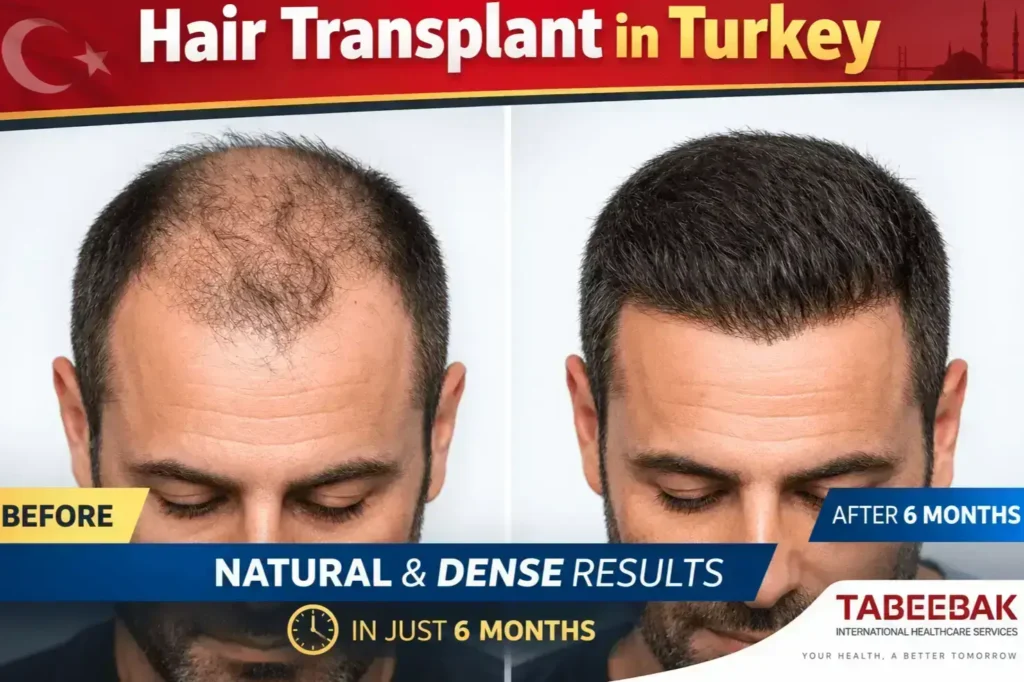
Choosing the right center is one of the most important factors affecting the success of a hair transplant. Do not rely solely on price or promotional before-and-after photos.
Before booking, consider the following criteria:
5. Realistic Promises
Avoid any center that promises guaranteed results or unrealistic density without first evaluating your condition. Hair transplantation in Turkey is a medical procedure, and results vary from one person to another.
Choosing Tabeebak Healthcare means you do not have to begin your treatment journey alone. We support you from your first inquiry through post-procedure follow-up, with Arabic-language assistance and clear steps.
What we provide:
Our goal is to help you have an experience that is as clear and safe as possible, with realistic expectations and a decision based on an appropriate assessment.
Get a Free Assessment Now
Send photos from the front, sides, back, and crown area, and we will help you determine: